✽ What We Offer
Incentive Tokens
Reward citizens for behaviours aligned with public policy objectives — sustainable mobility, environmental action, civic participation — through redeemable digital tokens.
Local Currency & Vouchers
Monetary instruments designed to direct spending toward local businesses and reinforce territorial economic circuits.
Liquidity Facilities
Alternative liquidity mechanisms — mutual credit, clearing systems, cooperative financial tools — to strengthen the financial resilience of local economic actors.
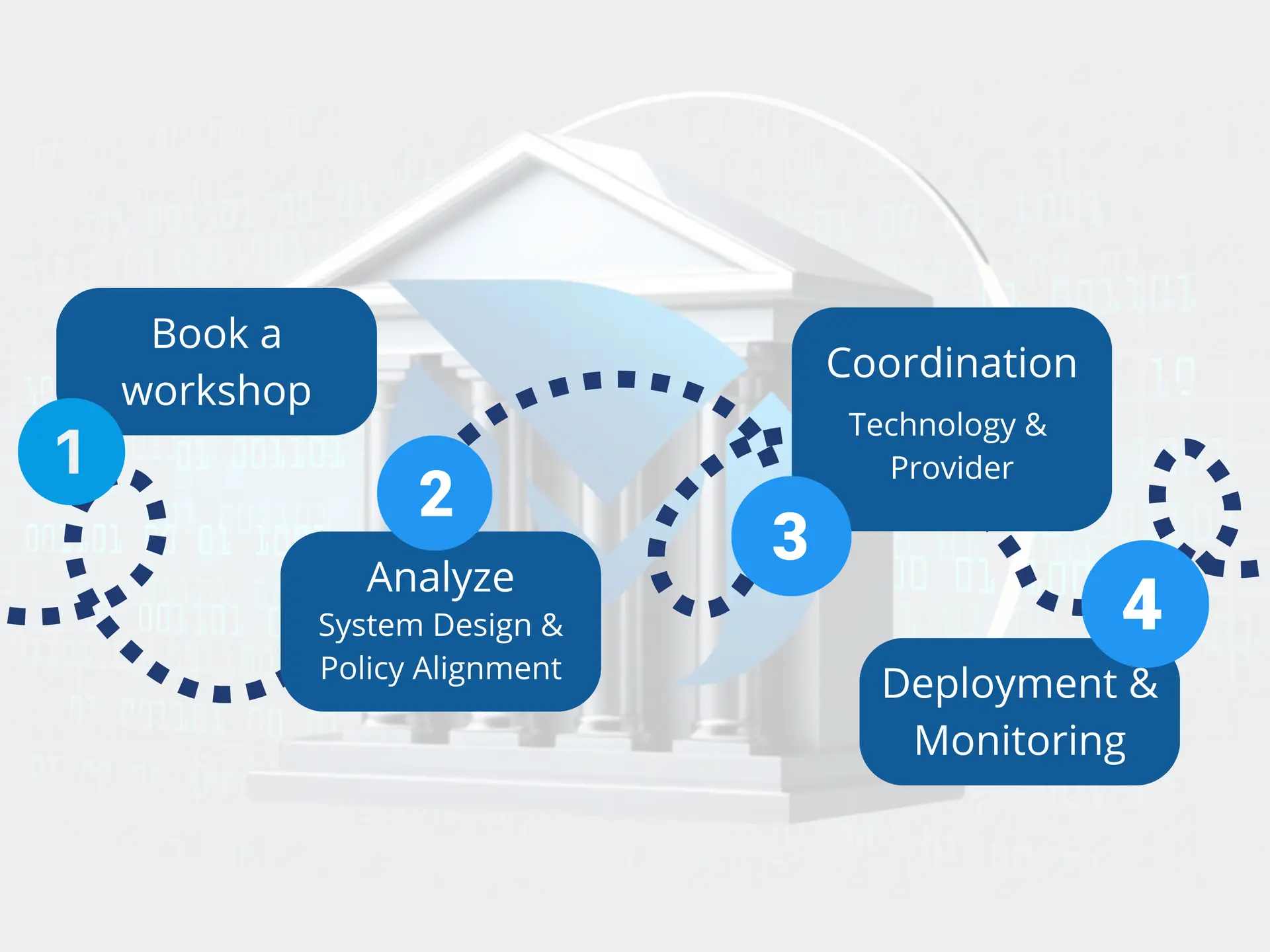
How we work?
Monetary mechanisms interact with legal frameworks, administrative procedures, political priorities, and territorial realities. As such, they require structured design and careful institutional alignment. This is where we excel at.
Our methodology follows five interconnected stages.

1. Strategic Framing
Every engagement begins with clarity.
Before discussing instruments or platforms, we work to define the precise policy objectives, constraints, and expected outcomes that you want to address with a monetary mechanism. This includes mapping institutional stakeholders, identifying administrative capacity, assessing territorial economic structures, and clarifying the strategic rationale.
Monetary design must serve clearly articulated public goals. Without strategic framing, implementation risks becoming symbolic or misaligned. Our first responsibility is therefore to ensure conceptual precision and policy coherence.
Our motto: We make public money work harder for local economies.

2. Architecture
Monetary systems must operate within existing legal, regulatory, and administrative frameworks.
We design mechanisms that integrate smoothly with public finance rules, accounting standards, procurement procedures, supervisory boundaries, and governance structures. Compatibility with national and European regulatory environments is assessed where relevant.
The objective is not to create parallel systems, but to construct financially sound and simple solutions that reinforce institutional stability and operate within established boundaries.
Institutional coherence precedes technical execution.

3. Governance Structuring
Durable systems require clear governance arrangements for daily management.
We help public authorities in defining roles, responsibilities, decision-making processes, oversight mechanisms, and interdepartmental coordination. Where external partners are involved, governance models are structured to ensure transparency and accountability.
Well-defined governance reduces operational risk, strengthens political legitimacy, and enables adaptation over time without destabilising the system.

4. Deployment Pathways
Implementation must be realistic and phased.
We assist in defining structured deployment pathways, including feasibility validation, stakeholder engagement, administrative integration, risk assessment, and coordination with technical providers, especially considering our large network of partners.
Particular attention is given to operational feasibility and internal capacity. The objective is to ensure that deployment strengthens existing administrative processes rather than adding complexity !
We keep it simple and efficient !

5. Monitoring and Evolution
Monetary systems are dynamic instruments operating within evolving economic environments.
We support the development of impact indicators, performance metrics, and evaluation frameworks that allow public authorities to monitor outcomes and refine mechanisms when necessary.
Reports help support the smart allocation of public money and document what we call : the local multiplier effect of public spending.